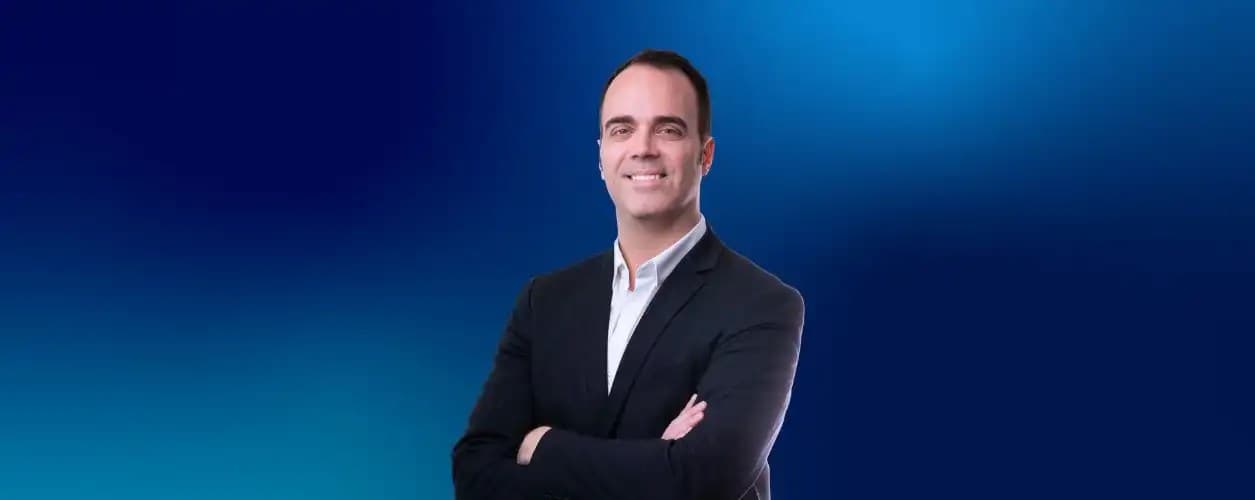
A Q&A with Assistant Professor Justin Baillargeon on immersive media and podcasting
Virtual reality (VR) is no longer a distant promise of the future – it’s a rapidly evolving medium that is reshaping how we learn, tell stories, and experience the world around us. From immersive entertainment to education, medicine, and training, VR is opening new frontiers across industries.
At the University of Niagara Falls Canada, Assistant Professor Justin Baillargeon is helping lead that conversation. A faculty member in the Master of Arts in Digital Media and Global Communications program, Baillargeon recently earned national recognition for his bilingual VR-focused podcast Dr. VR, winning Outstanding Technology Series at the Canadian Podcast Awards. We sat down with him to talk about what the award means to him, why podcasting is such a powerful tool, and where VR is headed next.
Some responses have been edited for clarity and length.
You recently received a Canadian Podcast Award for Outstanding Technology Series. What did that recognition mean to you both personally and professionally?
It was very special. It all started as a passion project, something I initiated during my research when I was writing my PhD dissertation. I wanted to share the knowledge of the interviews I was conducting with the specialists from around the world and XR (extended reality). I started recording them and decided to launch a podcast based on these interviews that I conducted, and a following just happened.
Even though I had finished writing my dissertation, I was driven by a passion. I keep telling my students, “If you're not driven by passion, it's going to be hard for you to accomplish what you want.”
More than two years after my podcast started, I won an award. It was a major accomplishment for me from a professional standpoint. It basically justifies that what I'm doing makes sense and has some sort of importance.
From a personal point of view, winning this award just gives me a huge sense of accomplishment and pushes me to continue even further in my activities.
What makes podcasting such a powerful medium for storytelling and education?
First of all, podcasting is available for anyone to try. Anybody with an internet connection and a phone with the capacity of recording a voice, has the ability to start a podcast.
Now, I do believe that everyone deserves to put their voices out there. Every voice is important, but it doesn't mean that every topic is important. I think that education is one of the driving forces of podcasting. It makes things more available. The accessibility of podcasting is what makes it so special. Now that we live in a completely digital world, accessibility is at the forefront.
Because of that, we're seeing that everything is being digitized. Radio stations are not as popular as they used to be 20, 30 years ago, but podcasting has been skyrocketing for the past 10 years. That shows how popular it is as a medium, and how strong it is as a way for people to educate themselves on specific topics.
I like to interview people for my podcasts who are specialized in specific topics regarding to immersive entertainment XR, from both an academic and an industry perspective. There are moments when we have a lot of fun and laugh during the interview, but I hope that people are going to be able to get something to educate themselves about a topic that is everywhere right now.
Your podcast bridges industry and academia. In your view, what makes VR such a compelling subject for long-form conversation right now?
We're at a very interesting time right now with VR. I feel it's really at a crossroad. From an industry perspective, people are seeing it as the new gaming console, and from an academic perspective, it's absolutely everywhere. Since its resurgence in 2016, people have been writing a lot about it and there is no journal without an XR article at the moment.
We are using VR as a mode to entertain people and to educate people. We use it in different areas, such as marketing and medicine. People are now practicing surgeries when they're thousands of kilometres away through immersive technology. We use it here at UNF and are currently working on our VR lab.
I believe that long form is the best way to go because we have so much to say, and a lot of people are not willing to sit down and read very lengthy academic articles about VR. I think that some of the developers out there need their voice to be heard, and that's why sitting down with them for around 45 minutes to an hour, talking about the reasons behind their creation and the achievement of what they're currently working on, to me, is the perfect way of giving them a voice and for them to educate us on the present and future of immersive technology and podcasting.
VR is often talked about as “the future,” but you’ve been studying it in real time. What misconceptions do people still have about VR, particularly outside the tech community?
People already think of VR as being dead. People have been talking about the end of cinema for 50 years now since the inception of digital technology, the beginning of the 2000s, and the arrival of streaming services. People are even talking about VR as the next gaming console – which is not true.
Studying in real time and through my interviews, I'm seeing how much of a fast-paced, evolving, medium and technology it is. Of course, gaming is a major part of it – it generates a lot of money, but we've seen terrible layoffs. So, there's more to that. There is more to just gaming, and the medium is not dead.
If we look back at the history of cinema, film started in 1895. During the 1910s, people started building movie theatres to accommodate the needs and the popularity of the medium. And in the 1920s, big major studios in Hollywood started to bloom. It's only in the 1950s that academia started being interested in the in the topic. So, there's a huge gap in between.
We're now in 2026. In just ten years since VR’s resurgence, we're now seeing huge festivals around the world. We have the immersive competition at Cannes. We have FIVARS (Festival of International Virtual and Augmented Reality Stories) in Toronto, who's been fully dedicated to VR for more than a decade now. We have many professors specialized around the world, so it shows how important it is.
I will reiterate: It is not just a gaming console. It is the medium of the future of spatial computing, spatial technology, and immersive embodiment.
You interview leading VR developers and innovators from around the world. Across all those interviews, what’s one insight or trend that really surprised you?
What surprises me the most is how much they're experimenting with the medium. Again, looking back at film, the very first five years was all about experimenting, trying to figure out what to do with that technology.
When I interview my guests, that's what they're trying to do. They're not looking at the headset in and of itself. They're looking at the artistic possibilities and the learning possibilities it has. So, they're really pushing the medium further while building the codes and the grammar for this wonderful medium. Just like we say, “We're building the plane as we're flying.” That's what they're doing.
As I was interviewing the Director of Programming at the Cannes Film Festival immersive competition, he said we're living in the Méliès-era of VR. That is, doing the best we can to wow people through some sort of magical tricks. In the Méliès film era of the late 19th century, we would see heads being removed and bodies disappearing. People did not have a single idea of how they were doing this.
But again, it's to attract people, and that's what they're doing for VR. They're accomplishing things that are absolutely insane. That's what moves the medium further. We're only ten years into that resurgence. Imagine where we'll be in 20 years from now with XR. I just cannot wait.
Is there a particular topic in VR or immersive media that you think deserves more attention right now?
The attention for doing good. People are seeing it as a mode of entertainment. A lot of the headsets are being sold with the conjunction of gaming possibilities. It's great because it generates a lot of money, but at the same time, I want people to understand that VR is more than just gaming.
It's doing a lot of good. It's treating people who are undergoing psychosis, for instance. They're also helping people going through burnouts such as nurses and doctors. We're also training people how to become firefighters using VR.
I want people to shift their perspective and see how VR is more than just a very heavy headset on your face. We need to focus on its possibilities and the good it can create and bring to people the people.
For students considering following in your footsteps and starting a podcast, what’s one piece of advice you’d give them?
They need to understand that their voices matter. Every voice matters and needs to be heard. We all have different perspectives. We all come from different avenues of life, different parts of the world. When you have a passion project, you should do everything you can to pursue it and to make it happen.
For the podcasting domain, it's important to find your niche. The narrower you get into finding your topic and talking about it, the more people you will attract to your audience. I like to think that's what I've been doing. I have already heard students creating their own podcasts for assignments. They are so talented and bring so many different flavours.
Again, if you have an internet connection and something that allows you to record your voice, you are ready to get the machine rolling. The main thing is to not stop. Do more than five podcasts. Once you have created more than five podcasts, you can definitely call yourself a podcaster. As VR continues to evolve, Baillargeon’s work highlights the importance of curiosity, experimentation, and passion in shaping emerging media. Whether through his award-winning podcast, research, or teaching at UNF, he is helping students and audiences alike better understand immersive technology.
